You ask your AI how to cook a turkey for Thanksgiving. It tells you how to cook a turkey breast, and when you ask again, it tells you how to fry one.
You wanted to bake a whole turkey. It had no way of knowing that.
The short answer
- Clear instructions answer the questions your agent would otherwise guess at.
- Before you write them, answer six: what a finished job looks like, what it must always include, your timelines, what it must never do, what went wrong last time, and what you expected as the client.
- Put the answers where your agent reads them every time it runs.
- When an answer comes back wrong, ask what detail you left out, and add it.
In this post
Why does my AI agent need such specific instructions?
Because it cannot read your mind, so every detail you leave out gets filled in with a guess.
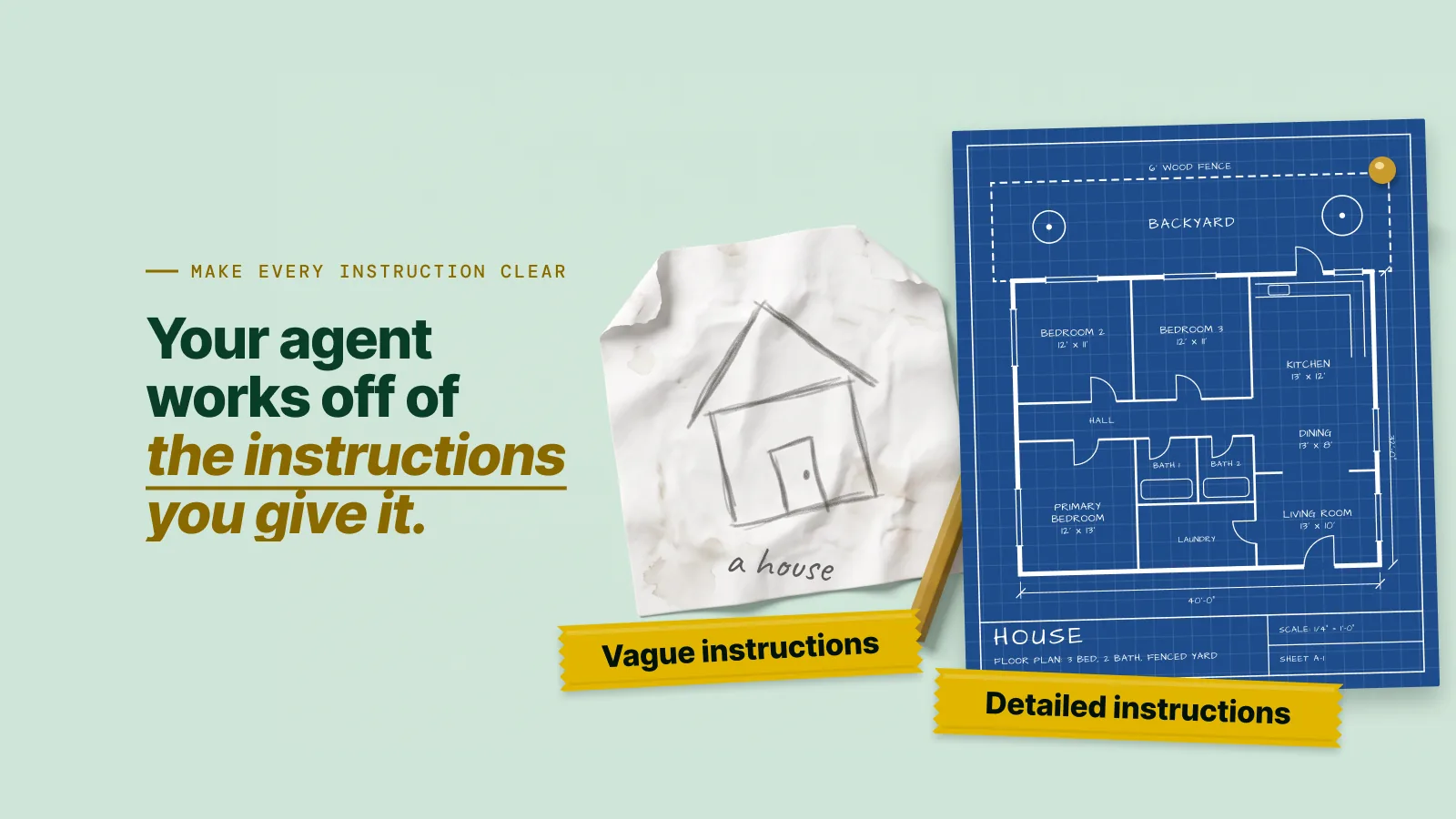
Go back to the turkey. You knew you wanted a whole bird, baked, for a family dinner. You typed “how to cook a turkey.” Everything you knew stayed in your head, and the AI filled the space with its best guess. Most people do not cook a turkey breast on Thanksgiving. The AI did not know that you were one of them.
Your agents work the same way, every single run. An email agent that was never told your offer writes around it. A content agent that was never told your voice borrows someone else’s. Then you spend the afternoon filling in what it missed, and the work you planned for the day waits.
If you work alone, there is no one else to catch the guess before it goes out. That makes the instructions matter more for you, not less.
The company behind Claude puts it this way: think of the AI as “a brilliant but new employee who lacks context on your norms and workflows.”1 A new person on your team would ask questions. Your agent usually guesses instead.
How specific should my instructions be?
Specific enough that it does not have to guess.
For the turkey, that sounds like this: give me a recipe for a 15-pound turkey, baked, with herbs and butter. The pounds, the style and the ingredients are all there. You could go further and name a region, like a Southern recipe, if that matters to your table.
For your business, it sounds like the same kind of detail. Which offer. What it costs. When the follow-up goes out. How you sign your name. OpenAI’s guide for people building agents says that being explicit about each action “leaves less room for errors in interpretation.”2
A good test: if you would have to explain it to a new person on your first day together, write it down for your agent too.
What should I know before I write my agent’s instructions?
Six things, and you already know most of them. Pick one task first, the one that gives you the biggest headache. Then answer these for that task alone.
- What does a finished job look like? If it went perfectly, what would you see?
- What must it always include? Your offer. Your business details. Your voice.
- What timelines do you expect? When does the follow-up go out? How long until a signed contract comes back?
- What must it never do?
- What did it get wrong the last time it ran? That is usually the detail you left out.
- What did you expect when you were the client? A follow-up. A receipt. Clear wording on a contract.
The last question is the one most owners skip. You have been the client of a coach, a consultant or a shop. You already know what a good follow-up felt like, and what it felt like to be left waiting. Those expectations are your standard. Your agent needs them in writing.
What do clear instructions look like for one task?
They read like a one-page sheet a new person could follow on their first day. Here is one written for a single task, the follow-up email after a discovery call, with each of the six answers in its own section.
Follow-up after a discovery call
A finished job looks like
A short email in my voice that thanks them, names what we talked about in one line, and gives one next step.
It must always include
- The name of the offer we discussed
- The price exactly as it appears on my website
- My booking link
- My sign-off
Timelines
It goes out the same day as the call. If there is no reply in three business days, one short second email.
It must never, without my approval
- Offer a discount
- Promise a start date
- Send anything
Last time it got wrong
It left out the price, so the potential client had to ask.
What I expected as the client
A follow-up the same day, a clear next step and no guessing about cost.
Step-by-step procedure
Each step says who does it: a tool, you, or a team member.
- 1
Read the notes from the call Tool
Pull out the offer they asked about and the one next step.
- 2
Draft the email Tool
Due: The same day as the call
Use every item under It must always include.
- 3
Approve and send YouNeeds a decision
Read it once. Send it, or send it back with what is missing.
- 4
Second email if there is no reply Tool
Due: Three business days later
Two or three sentences, the same next step, sent after your yes.
Completion criteria
The email is sent the same day, and the potential client knows the offer, the price and the next step without asking.
A sample set of instructions
Notice what is missing from the sheet: anything clever. It is plain. It names the offer, the price, the timing and the one thing it must never do. The approval step stays with a person. I build every system that way, and you can see how on North Star Operations.
If the steps look like a procedure, that is because they are. A standard operating procedure and a set of agent instructions answer the same questions. One is written for a person and one for your agent.
What if I do not know all the answers yet?
Start with the one task that gives you the biggest headache, and use AI to help you think it through.
I avoided this part for a long time. Sitting down with all of those details felt like more overwhelm, and I was already overwhelmed. So I kept going back and forth with my AI instead, every day, trying to get it to run the way I wanted. It could not, because I had never been clear with myself.
When I finally sat down and did it, it took about a week. That week saved me two months of daily frustration.
You do not need a week to start. Give one task an hour or two. Open a chat with your AI, tell it which task you are working on, and ask it to walk you through the six questions one at a time. It can ask you what you have not thought of yet. You answer. Then the answers go into the agent’s instructions.
This is the part nobody shows you after the agent is built. If yours keeps redoing work you already finished, or carrying more than one job, clear instructions are where the fix starts.
When your instructions are clear, you get more done in the day you planned, and you can step away from the desk without wondering what it missed. Which task would you start with?
Sources
- Anthropic, "Prompting best practices," Claude platform documentation, section "Be clear and direct." No date shown. Read November 19, 2026.
- OpenAI, "A practical guide to building agents," section "Best practices for agent instructions." No date shown. Read November 19, 2026.
The cover pictures in this series are AI-generated illustrations.

Written by Kalilah Hudson
Kalilah spent fourteen years writing procedures and training the departments that ran them. She now builds the systems service businesses run on through North Star Operations.
Every Monday she sends one part of your sales and client system in The North Star Newsletter. Get the weekly guide.